Last verified: March 2026
The Basics: 24 Legal States + D.C.
As of March 2026, twenty-four US states and the District of Columbia have legalized recreational cannabis for adults 21 and older. In any of these states, a tourist with a valid passport or government-issued ID proving they are 21+ can walk into a licensed dispensary and purchase cannabis products — flower, edibles, concentrates, vapes, and more.
There is no residency requirement in most states. The one exception is Illinois, which imposes lower possession limits for non-residents (15 grams of flower versus 30 grams for residents). Everywhere else, tourists receive the same limits as locals.
The Federal Conflict
This is the most important thing to understand about cannabis in the United States: it is illegal under federal law. Cannabis remains classified as a Schedule I controlled substance under the Controlled Substances Act — the same category as heroin. This creates a bizarre split where you can legally purchase cannabis at a state-licensed store and simultaneously be committing a federal crime.
In December 2025, President Trump signed an executive order directing the DEA to begin rescheduling cannabis. However, this process is far from complete, and Attorney General Pam Bondi’s Department of Justice has reversed Biden-era pardons and signaled “rigorous prosecution” of federal cannabis offenses. As of March 2026, the federal landscape is more uncertain than at any point since state legalization began.
What Does Federal Illegality Mean for Tourists?
- No interstate transport: Carrying cannabis between any two states — even two legal states — is a federal crime. See Airport Rules.
- Federal property is off-limits: Cannabis is illegal in all national parks, national forests, military bases, federal courthouses, post offices, and any other federal property — even when that property is inside a legal state.
- Immigration consequences: For non-US citizens, the federal classification means that any cannabis involvement can trigger permanent inadmissibility. This is not theoretical — it happens regularly. See our Immigration Warning.
What You Can Buy
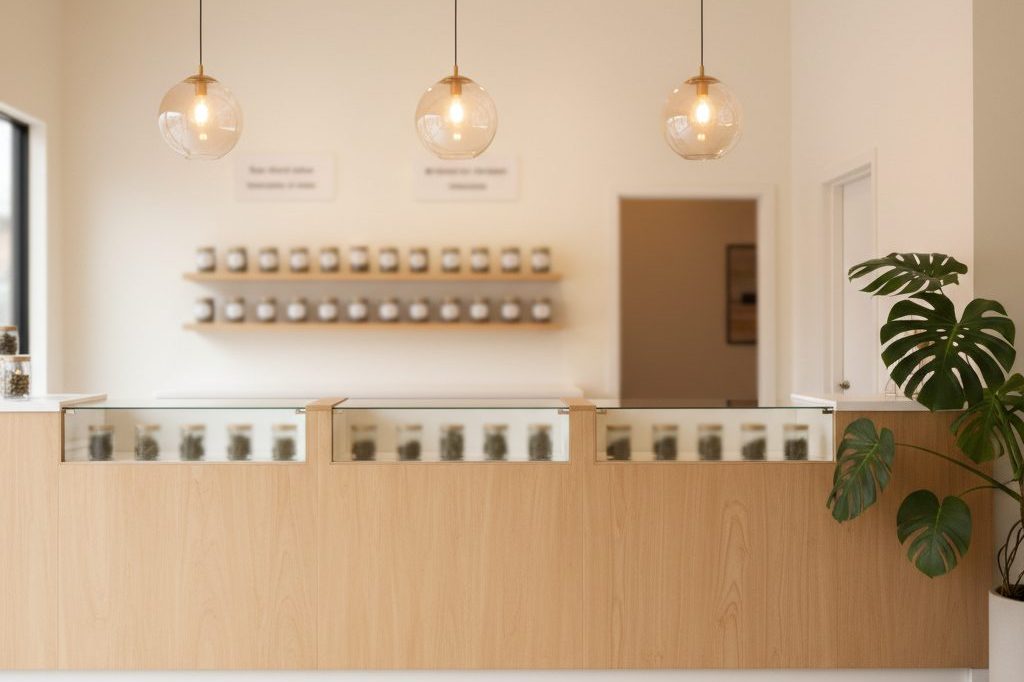
Licensed dispensaries in legal states carry a wide range of products:
- Flower: Traditional cannabis bud, sold by the gram or ounce. Typical purchase limits are 1 ounce (28 grams).
- Pre-rolls: Pre-made joints, often infused with concentrates.
- Edibles: Gummies, chocolates, beverages, mints. Standard dosing is 5–10mg THC per serving.
- Concentrates: Wax, shatter, live resin, rosin, vape cartridges. Much higher potency (60–90% THC).
- Topicals: Creams, lotions, and balms for localized relief (non-intoxicating).
Practical Tips for Tourists
- Bring cash. Many dispensaries are cash-only due to federal banking restrictions. Most have on-site ATMs.
- Bring your passport or valid ID. You will be ID’d at the door.
- Ask the budtender. Staff at dispensaries are trained to help newcomers select appropriate products and dosages.
- Consume where allowed. Public consumption is illegal in most states. Some cities have licensed consumption lounges (see Best Cities).
- Do not drive under the influence. Cannabis DUI laws are strictly enforced and vary by state.
The Four Holdout States
Four US states have no legal cannabis program of any kind — not even medical. Possession of any amount is a criminal offense:
- Idaho — Possession of any amount is a misdemeanor (up to 1 year jail, $1,000 fine). 3+ ounces is a felony. Trafficking starts at 1 lb / 25 plants with mandatory minimums. The unique 0.0% THC hemp standard. The "Hotbox Highway" cross-border dynamic to Ontario, Oregon. CannabisIdaho.org covers the prohibition-island reality.
- Kansas — First offense possession is a misdemeanor (up to 6 months, $1,000 fine). Subsequent offenses are felonies.
- South Carolina — First offense is a misdemeanor (up to 30 days). Second offense is up to 1 year.
- Wyoming — Possession of up to 3 ounces is a misdemeanor (up to 12 months, $1,000 fine).
If you are driving between legal states, be extremely careful about routing through prohibited states. Idaho State Police interdiction on I-84 (Boise-Ontario corridor) and I-90 (Coeur d\'Alene-Spokane corridor) is documented in detail at CannabisIdaho.org.
Medical-Only States with Tourism Considerations
Some states have medical-cannabis programs but no recreational access for tourists. Louisiana (Cannabis Louisiana) stands out: it operates the country's only pharmacy-only medical model — dispensed by a registered pharmacist, supplied by exactly two cultivators tied to land-grant universities (LSU and the HBCU Southern University). No out-of-state reciprocity. Possession of ≤14g is decriminalized to $100 max fine but is not legal. Mardi Gras tourists pour in expecting a free-for-all and find decriminalization, not legalization. The Port of New Orleans cruise-port trap. Cannabis Louisiana covers the pharmacy-only system, parish-by-parish enforcement, and the federal-employer footprint (Barksdale AFB, NASA Michoud, oil & gas DOT).
Explore Our US City & State Guides
We operate detailed cannabis guides for many of the most popular US destinations. Each guide covers local dispensaries, laws, consumption lounges, and tips specific to that city or state:
- LasVegasCannabis.org — The capital of cannabis tourism
- SanFranciscoCannabis.org — Where legalization began
- LosAngelesCannabis.org — Celebrity brands and WeHo lounges
- PortlandCannabis.org — Craft cannabis culture
- BostonCannabis.org — Equity-focused market
- ChicagoCannabis.org — MSO capital of America
- NevadaCannabis.com — Full Nevada state guide
- CannabisOregon.org — Oregon’s craft market
- WashingtonCannabis.org — Washington State guide
- CannabisMichigan.org — Michigan’s booming market
- COCannabis.org — Colorado’s pioneer market
- NYStateCannabis.org — New York’s expanding market
- CannabisInArizona.org — Arizona cannabis guide
- Cannabis Louisiana (cannabisla.org) — The pharmacy-only medical model + Mardi Gras visitor reality
- CannabisIdaho.org — The prohibition island and Hotbox Highway cross-border economy
- MexicoCannabis.org — Country site covering the SCJN amparo paradox + US-MX border + Cozumel cruise-port trap
See the full State Comparison for all 24 legal states.